Why Classic Ads Still Outperform Most Modern Ones
Modern ads often feel loud, expensive, and instantly forgettable. If you’re writing copy, running paid social, or building a brand, that’s a real problem. Classic ads solved attention and trust with fewer tools and tighter ideas. This article shows what they did differently and why it still works.
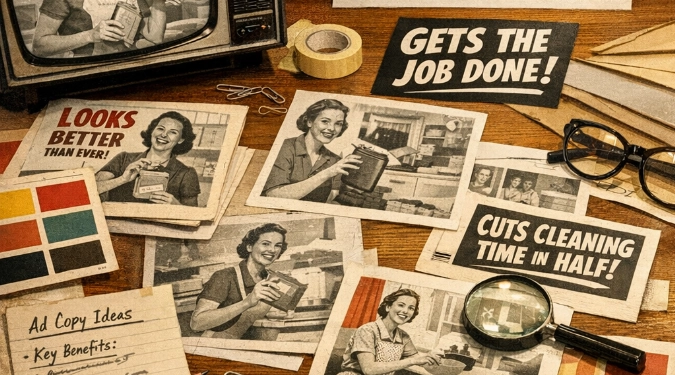
You’ll learn six rules classic ads used to win attention fast. You’ll see how to steal their structure without copying their style. This guide also gives a rewrite checklist you can apply to one ad today. Use it for landing pages, emails, and short video scripts right away.
They Sold One Clear Thing
Classic ads picked a single promise and drilled it in. They did not stack five benefits to “cover more audiences.” The message was easy to repeat at a dinner table.
Think of “Melts in your mouth, not in your hands” from M&M’s. Or “The pause that refreshes” from Coca-Cola. Each line is one job, done well.
Modern ads often lead with vibes, not an offer. Fix it by writing a one-sentence claim. Then delete every line that does not support that claim.
They Made Proof Feel Concrete
Old work leaned on demonstrations, comparisons, and constraints. It was less “trust us” and more “watch this.” That matters when attention is cheap and skepticism is high.
Volkswagen’s “Think Small” made size a feature and framed the tradeoff. Avis used “We’re No. 2. We try harder.” The proof was behavioral, not mystical.
Build proof in three ways. Show a test. Show a number with context. Or show a specific process step you control.
They Obeyed The Two-Second Layout
Great print work assumed the reader would skim. Headline first, then image, then a short bridge to body copy. The structure worked because it matched how eyes move.
Many Nostalgic Print Ads used a big headline with a sharp point of view. The body copy then answered objections in plain language. You can still use that arc on a product page.
Try this layout. Write a 7 to 10 word headline. Add a subhead that explains the “why.” Then add three bullets with proof and constraints.
They Built Characters, Not “Targets”
Classic campaigns wrote to a recognizable person with a problem. The voice had confidence and a specific worldview. That is why the copy still reads human.
Think of Marlboro’s cowboy archetype, minus the ethics. Or Nike’s early “Just Do It” energy aimed at everyday grit. The work spoke to identity before it asked for action.
Pick one character for your next ad. Give them a job title, a daily frustration, and a private fear. Write one line that proves you know that inner monologue.
They Repeated Distinctive Assets
Old brands were obsessive about consistency. They repeated colors, shapes, mascots, and taglines. That repetition built memory, which lowered future ad costs.
Examples are easy to spot. Apple’s early minimalist product focus. McDonald’s golden arches and “I’m lovin’ it” era consistency. De Beers repeating “A diamond is forever.”
Audit your assets. Pick one color, one type style, one sonic cue, and one tagline rhythm. Repeat them for 90 days before you “refresh.”
They Used Constraints To Sharpen Creativity
Many Retro Commercials were limited by time and production. That forced simple stories and strong openings. The first five seconds mattered because there was no skip button.
Use constraints on purpose. Limit your ad to one scene. Limit your script to 60 words. Limit your offer to one primary outcome.
Constraints also protect you from feature creep. If a feature does not support the promise, it is not in the ad.
A Rewrite Checklist You Can Use Today
- Write the claim: One sentence a customer would repeat accurately.
- Pick the proof: A demo, a number, or a process step.
- Name the tradeoff: What you do not do, or who it is not for.
- Design the skim: Headline, subhead, then three bullets.
- Add one asset: A consistent line, color, or sound cue.
- Cut the fog: Remove “innovative,” “premium,” and “solutions.”
If you want inspiration, study Timeless Marketing Campaigns that kept the same spine for years. Also study Iconic Tv Spots that open with conflict, not logos. Then apply Classic Branding Strategies by repeating what works, not what is new.
References
- Ogilvy, David. Ogilvy on Advertising.
- Bernbach, Doyle Dane Bernbach archives and campaign retrospectives.
- Ad Age. Historical campaign coverage and brand timeline summaries.
Disclaimer: The information provided in this article is for educational and informational purposes only. It does not constitute professional advice. Readers should conduct their own research and consult with qualified professionals before making any decisions.